Tag: womens literature

  • Glowing By the Light of “Frail Little Embers”: A Literary Review of new Short Story Collection

    Glowing By the Light of “Frail Little Embers”: A Literary Review of new Short Story Collection

    fire in a metal barrel surrounded by rocks

    It was a delight to read “Frail Little Embers” by Fjia Callaghan, this collection of short stories is a sweet and tender package of magical realism. There is tea, handmade candy, visits to the sea, folklore both light and dark, and subtle tension woven through each story. Her passion for using myth and folklore “to creat stories that give people hope in times of darkness”, as stated on her bio, is evident in this collection. 

    “Running with Wolves” is a gentle retelling of Red Riding Hood when the roads are closer to the woods and Red has a smartphone. The beauty of a short story is the way in which it can tell us a lifetime of sorrows and joys in one small passage of time and we experience this repeatedly through the collection.

    Callaghan plays around with form, such as in “September Sunsets” and passages of evocative and whispery poetry. It works in this story but I’m unsure how necessary it is within the context of the entire collection. At the same time, the structure of the story is in sharp contrast to the many ways Emily misunderstands everyone around her, from her daughter to the man who  brings her firewood.  

    There are certain lines throughout this short story collection that are devastating in their lyrical beauty, “I curled up in a ball of smoke and shadow and ached for all the things I didn’t understand” (Callaghan, 141) from the Edge of Morning made me pause while reading. This was my favourite in the entire “Frail Little Embers” collection, it showcases Callaghan’s form and the way her writing is like a song.

    At twenty-one stories, I think it’s fairly long for a short story collection. Some stories, like “The Fleeting Ones” read like a character sketch with limited plot but a lot of foreshadowing that could have been fleshed out in a meaningful way. There’s potential to fill in the spaces and if anything, there’s more than one collection here if the time had been spent to find them. This could be coming from a selfish place as I look forward to reading more from Fjia Callaghan.

    Recommended to readers who enjoy whimsy and delight, magical realism, folklore, myth, and magic.

    “Frail Little Embers” was published on 8 April 2025  by Neem Tree Press, thanks to them for making the title available on Netgalley for review!

    Did you know I’ve started publishing my own short fiction? You can find it over at Under the Poplar Tree on Substack. Be sure to subscribe, I publish a new short story every other Thursday.

  • Gauzy dust-filled horror: Review of The Atropine Tree

    Gauzy dust-filled horror: Review of The Atropine Tree

    Aldane Manor is an ancient home of low-beamed ceilings, crumbling walls, poison gardens, and deadly secrets.

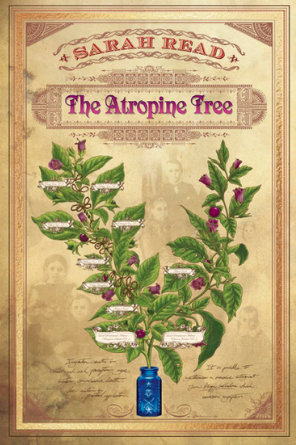
    Front cover of The Atropine by Sarah Read. Sepia toned background with a hand drawing of a two stems of a plant with red berries and green leaves like a fern, in a blue bottle.

    The Atropine Tree by Bram Stoker award-winning writer Sarah Read is a delightful romp into the absurdity of gothic horror. A medium sister, one who talks to ghosts – not size medium, poison herb gardens, centuries of ghosts and strangely uneven floors, and herb-laden fires stoked too high all lend themselves to creating a heady, gauzy feeling that immerses the reader. Gothic horror is meant to be over the top, absorbing in its terror and in Read’s very capable hands, The Atropine Tree is incredibly engrossing. I lost an entire afternoon to the world of Aldane House.

    It is overwrought in the very best ways, richly detailed as I could easily picture Nelda’s dramatically stained lips and teeth and feel the deep luxury of the carpets in her room. I don’t think I breathed when her room became crowded and overstuffed and heated, much like Alrick.

    Fiction like The Atropine Treeis the very best of escapist reading, and even though no one could possibly take that many herbal pastilles and antidotes, it’s immensely entertaining and Read’s writing is so richly detailed and engrossing, it is like having a movie play in your mind while reading.

    The story is like something out of the other side of the Dickens looking glass, with its usurper heir and street urchins languishing in the workhouse. 

    Highly recommend to anyone looking to escape into an absorbing, dust-filled horror, lovers of truly beautiful prose and anyone who simply likes to read because Read is a very talented wordsmith. The genre of horror shouldn’t dissuade any readers from picking up a copy of The Atropine Tree, it was so enjoyable to read.

    Many thanks to Bad Hand Books for sending a copy my way! Check out their website to order your own copy and check out some of their other titles. Check out my review of Bad Hand’s short story collection, Long Division.

    Did you know I also write short fiction over at Substack? Check out Under the Poplar Tree if you like my writing and want to read more of it.

  • Review of a Poet’s Memoir: Looking at Women, Looking at War by Victoria Amelina

    “What weapons do we choose to pursue justice in the hardest times?

    Victoria Amelina, Looking at Women, Looking at War

    The memoir “Looking at Women, Looking at War” is one writer’s journey to answer this question in the face of occupation and war. Victoria Amelina, children’s literature author and mother to a young son was confronted with this question on February 24, 2022 when Russia invaded Ukraine and her world was upended. The resulting memoir is her experience as a war crimes researcher and writer reconciling with her own identity and the “forever endangered Ukrainian culture”.

    An honest and intimate chronicle of her own experience, it is also of other extraordinary women in the resistance. Women like Evgenia, a prominent lawyer who were colourful clothing to court, but now carries a gun at the frontline. Oleksandra, her friend and mentor, who documented tens of thousands of war crimes and won a Nobel Peace Prize in 2022, though not one of her hundreds of cases went to The Hague in the seven years prior. The finer details like this sucked the air out of my lungs while reading. This book offers brilliant insight into the experience of women in and at war, but it is also contemporary evidence of Russia’s criminal attack on Ukraine. It is undeniable yet it continues.

    War is absurd and relentless and evil, a continuing slog of noise and death. Victoria Amelina captures the unspeakable despair and moments of joy that are the experience of war. It is an assault on the senses and in juxtaposition she writes of feeling disconnected and worn out. Body tired from the trauma and grief. Oleksandra tells her to take time and put cream on her face but to really feel it before she does anything else. How often do we do something similar? This sensory experience is a return to another time and a centring moment before she returns to recording war crimes and atrocities.

    This book could so easily be a litany of awful events pieced together, but it is instead a raw and lyrically beautiful account of a woman making her way in a world of war, attempting to create a path for justice. The awful things are alluded to but Amelina is a writer of grace and compassion, the reader can understand the allusions to violence and sexual assault without needing the details.

    The manuscript is unfinished. Victoria Amelina’s life was cut short by a Russian missile attack and she died on 1 July 2023. There are sentences left undone because of her death. Fragmented notes tell of awful Russian actions, like the small bit of a master’s work that could be seen on a FaceBook photo, posted by the Russian soldier who stole it Half of a sentence tells us about the death of a man miraculously rescued in another chapter. I had to stop reading and watch the crows in my favourite tree for a while after that. There is no ledger of fairness in war.

    Amelina reveals the bleak despair wrought by the violence of war and the fear of being close to death so that we can understand the small ways people are trying to retain their humanity in the face of war. The bag of walnuts a mother gives to Victoria after their interview. The reader is brought into the group of artists trying to save a snag beetle found on the sidewalk,their attempt to save an inconsequential life after the gut punch of learning about Volodomyr Vakulenko’s abduction by Russian forces. His death is a terrible thread woven through the novel and each time we are reminded that Amelina was writing about friends and colleagues. She is not simply an outside observer in this conflict.

    Reading this makes me consider what I would do if my country came under attack and I had to face the reality of war crimes and terror. Would I be brave and charge into the war zone to document the horrors done by the enemy? Would I find a sturdy basement and plead with my neighbours to find shelter with me? I should hope so, and I think we can hold on to what Victoria Amelina says here: “No choice made by those who want true justice is easy, and for most of us, the outcome of our battle is still unknown.” (p.10)

    Victoria Amelina’s roots as a storyteller can be found “Looking at Women, Looking at War”, evident as she set out to chronicle the lives of extraordinary women. In writing about the people in the embattled Donetsk region, we’re invited into her inner world and what made her courage necessary. Such is the cost of resistance.

    Recommended to readers who enjoy history and women’s literature. The memoir requires patience, broken sentences will never be fit together, we won’t ever have answers as to what she intended in some sections. The tragedy of war exists in these gaps. “Looking at Women, Looking at War” will be be published 18 February 2025 and available at all fine retailers and booksellers after that date.

    For further reading, check out Hunting for Vakulenko to read more about the poet and his abduction and murder by Russian forces. A murdered writer, his secret diary from the Guardian provides further context about Vakulenko.

  • Devastating Minutiae in the Palestinian Experience: A Literary Review of Minor Detail

    Devastating Minutiae in the Palestinian Experience: A Literary Review of Minor Detail

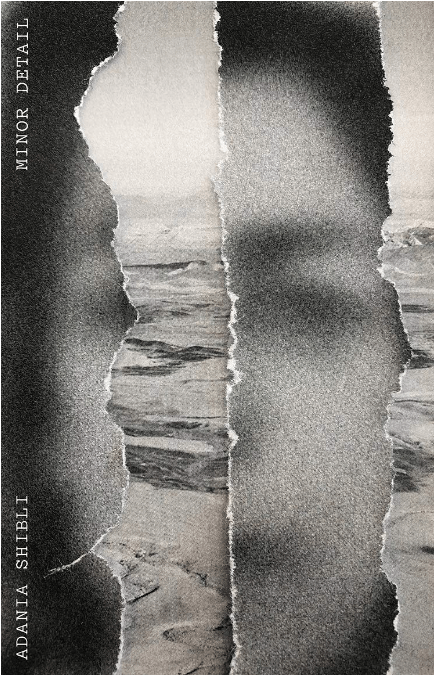
    Recently, while combing the Libby archive, I came across the audiobook of “Minor Detail” by Palestinian author Adania Shibli, translated by Elisabeth Jaquette. “Minor Detail” immerses the reader into the summer of 1949, one year after the horrific Nakba where around 700, 000 Palestinians were displaced. In this already violent and oppressive environment, Israeli soldiers encounter a Bedouin encampment and proceed to kill the group of unarmed Arabs, except for one scared girl. The soldiers eventually kill this young woman and bury her in the sand of the Negev desert. Years later, in a present-day similar to our own, a young woman in Ramallah comes across a newspaper article about this terrible history and attempts to learn more about the crime, notable to her because it was committed exactly twenty-five days to the day she was born. This incredible fiction novel is a devastating look into the banal minutiae of life under oppression.

    The novel is divided into two equal parts. Part one is the narrative viewpoint of an Israeli army officer who has been sent with his men to lead patrols of the desert to ensure it is free of the nomadic Arabs who lived there. The soldiers find the Bedouin encampment and kill all the unarmed people and their camels, the oppressive heat and details of the blood seeping into the sand evoking a deep seeded, visceral discomfort with state sanctioned imperialism. It is from this encampment the soldiers take the unnamed Bedouin girl they will murder.

    Shibli very effectively builds tension and discomfort by constantly revisiting the exacting details of the officer’s infected spider bite on his leg, the measured ways he cleans his body each time he returns to his tent, the care he takes in dressing the wound and ridding his space of any other spiders. He is fastidious in cleansing away rot, within himself, his own troops and the desert. Shibli’s writing is very tightly wound in this section, the close heat and dank smells seem to rise up around the reader.

    The second section of “Minor Detail” follows a young, unnamed Palestinian woman after she encounters a newspaper article about the 1949 murder. She is drawn to the story and feels compelled to learn more about the crime and the victim. There’s a longish section where she muses about her own narcissism that is a bit much in its melodrama, reminiscent of a teenager’s navel gazing, but I think the overwrought language has more to do with translation than Shibli’s writing. There’s another passage that overuses the word “leaped”, to the point of distraction but again, some nuance and lyricism can be lost in translation. The rest of the writing is evocative and lyrical, in spite of the violence and cruelty that is sometimes depicted. 

    Our narrator is forced to navigate a land under occupation as Palestinians can only make their way around Israel in very controlled and contrived circumstances. In this way we see how the barren landscape, once it was cleared of nomadic Arabs, has been built up to be a very tightly institutionalized space. The chaotic violence of the Bedouin girl’s murder has given way to cities and countries in controlled zones with permits that are enforced with ruthless zeal. We experience the shifting borders of these controlled zones with the narrator as she switches between multiple maps in an attempt to plot a course through a land once hers but now marred by institutions that bar her entry.

    Shibli’s writing is subtle and poetic, with a magnetic pull into overbearing heat and tension. We know the violence takes place and we know it is brutal, but Shibli deftly carries the reader around and past the acute action of violence and into its aftermath. In this way, she is evoking that sultry heat of a sun-baked desert that throws up mirages and disorients the experience.

    The sexual assault and murder of the young Bedouin woman in 1949 is a true story, one small unbearable story in a terrible war. A devastating microcosm of the whole. This is the true, horrible beauty of Adania Shibli’s “Minor Detail”, each observation carefully and tenderly drawn out. Regardless of politics, recommend to readers interested in fine literature, perspective changes in fiction, women’s experience in writing. 

  • Books I Read in 2024 that Made an Impact

    The following, in no specific order, is a round of eight books I read in 2024 that made an impact on me. The phenomenal books on this end of year list are not all new releases, some are a few years old and one is considered a classic. There’s fiction and non-fiction alike, murder, sex workers and difficult women. It doesn’t even encompass the many books I read or listened to that I truly enjoyed. These are the books that immediately came to mind when I sat down to reflect on what made me say, shit, that was a great book, then stare ahead and absorb the words. Without further ado, the Eight Books of 2024 That Made an Impact (on me):

    Whores, Harlots and Hackabouts, Kate Lister: Sensational. I listened to the audiobook, narrated by Professor Lister, and she has a fantastic northern English accent that carries you into the history. She is thoughtful in addressing a really difficult subject, compassionate and uproariously funny. Sex work isn’t the oldest profession, as she argues in the book, but it is very old and it is one that is frowned upon unless you have the right economic status and pretty face. History is ridiculous and hilarious, but it’s also a rich resource for us to learn and Kate Lister is one of my favourite guides.

    The Five, Hallie Rubenhold: The first Jack the Ripper book I read was the famous narrative that put forward Queen Victoria’s grandson as the murderer. We had recently moved in with my grandmother and I had started raiding her bookshelves (also where I found a sensationalized account of the Black Donnellys). “The Five” is nothing like that 1970s pulp non-fiction, though Rubenhold does reference it in her very well-done book about the five victims of Jack the Ripper. She eloquently breathes life and some agency into these women who were brutally cut down, their memory intertwined with their unknown murderer for generations. You can find my review here. 

    Sinister Graves, Marcie Reardon: This is the third instalment in the Cash Blackbear series by Reardon. I discovered the first in her series, the award-winning Murder on the River, as a happy accident at the library. Cash Blackbear is an intriguing Native American woman with abilities to see things not of this world and she assists a local police officer, who has also become her mentor and only family. Book four in Reardon’s series is coming out in 2025, so I’m looking forward to that!

    Parable of the Sower, Octavia E. Butler: Absolutely quintessential and necessary reading for anyone who is interested in speculative fiction and post-apocalyptic stories, but also philosophy and the human experience. Butler is an absorbing writer, her broken world, before it became that way, is unsettling in how familiar it is, but that is why post-apocalyptic storylines work so well. They are both a cautionary tale and a horror that could never happen. 

    Difficult Women, Roxane Gay: A powerful, painful and beautiful collection of short stories. Roxane Gay is a professor, editor, social commentator (from Twitter to the New York Times) and writer. This collection is raw and spectacular, it reveals bits and pieces and of what makes us whole.

    The Wife Between Us, Greer Hendricks and Sarah Pekkanen: A slow burn psychological thriller, “The Wife Between Us” is a great read as the weather chills and you have the opportunity to sit snuggled up by a fire. The storyline takes us back and forth between Vanessa, the scorned ex-wife of Richard, and his new fiancée Nellie. The women’s lives are intertwined in ways the reader would never expect. 

    Calling My Deadname Home, Avi Ben-Zeev: I loved this incredible memoir by Dr. Ben-Zeev. An honest and very loving look into the life of a trans man trying to heal himself and the journey with his family and loved ones. You can read my review here

    As 2024 unravelled and unfurled into whatever will come in the next year, these books were more than just stories. Each brought its own wisdom, touch of magic and introspection, growth and tears, which is a testament to the formative power of reading. A well-told story can change how you see the world. 

    What were books that impacted you the most this year? Share your favourites below in the comments, I’d love to hear other readers’ reflections and recommendations.

  • Cocktail Book Review: Lisa Alward’s Masterful Storytelling is a Must-Read

    Cocktail Book Review: Lisa Alward’s Masterful Storytelling is a Must-Read

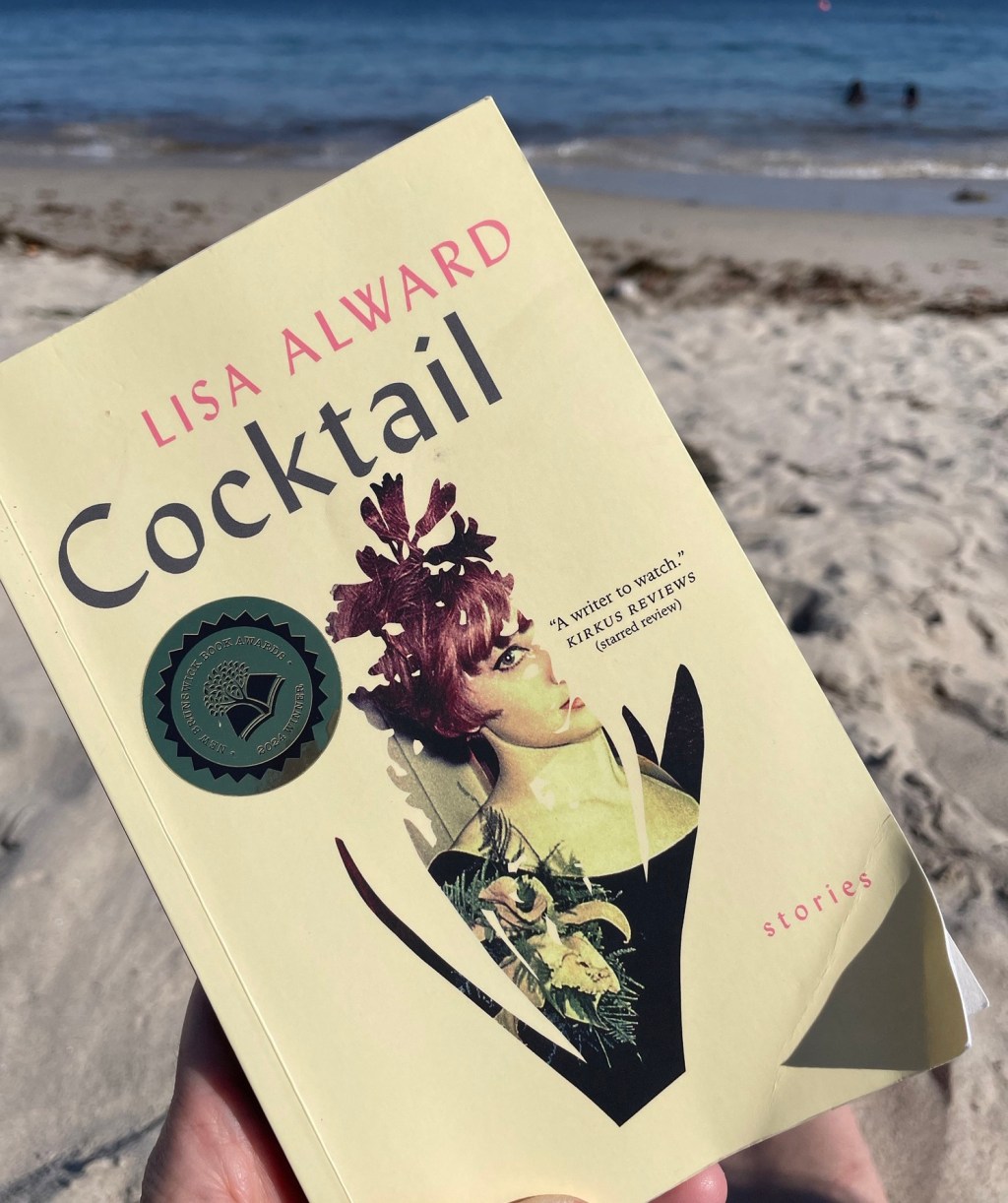
    I found Lisa Alward’s “Cocktail” on a visit to Fredericton this past summer. We visited Westminster Books, as well as the phenomenal Lord Beaverbrook Gallery a few blocks away. Published in 2023 by Ontario-based Biblioasis, “Cocktail” was Longlisted for the 2024 Carol Shields Prize for Fiction and appeared on the Globe and Mail’s “Sixty-Two Books to Read this Fall”. This collection of twelve short stories was an absolute boozy and nostalgic delight to read. 

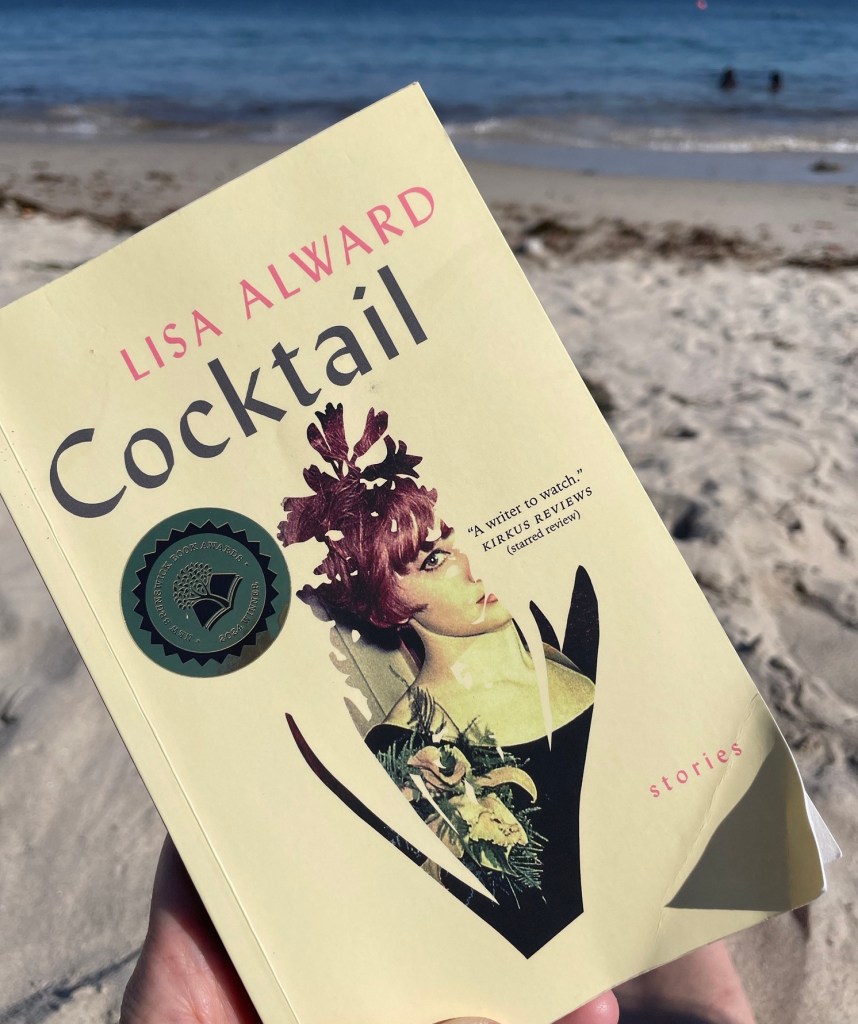
    Image of front cover of "Cocktail" by Lisa Alward. The book is held at an angle by a hand and there is a sandy beach with gentle waves in the background.

    The collection delves into the complex inner lives of relationships, and deftly encapsulates searing and poignant moments in time. Alward effectively infuses each story with rich detail and simmering emotion. Spanning the decadent 1960s to the present, the characters are middle class and sometimes willingly obtuse in navigating their space, but such is the beauty of life. We are welcomed into a world where people see the world through a lens awash in dimmed sepia tones and shag carpeting.

    Image of title page of "Hawthorne Yellow" held against a blue sky

    “Hawthorne Yellow” is an intricately woven tale in which we feel the humid tension building between a house painter, a young couple and the things an old house can hide. Such is Alward’s ability and precision in capturing the emotion in a short period of time. 

    The characters face the regular upheavals that come with having relationships, and the way desire can be more of a haunting as in the title story, “Cocktail”. 

    Lisa Alward’s “Cocktail” has earned well-deserved critical acclaim. The characters and sense of them lingers long after reading the collection.

    Recommended to lovers of short fiction, readers who enjoy emotionally detailed and rich literary fiction. Written from a feminist perspective, “Cocktail” explores themes of love, loss, redemption, female anger, social expectations and concepts of motherhood. Available at all fine retailers, but most especially at a local independent seller.

  • Characters Take Flight in MONARCH: Literary Review of New Short Story Collection

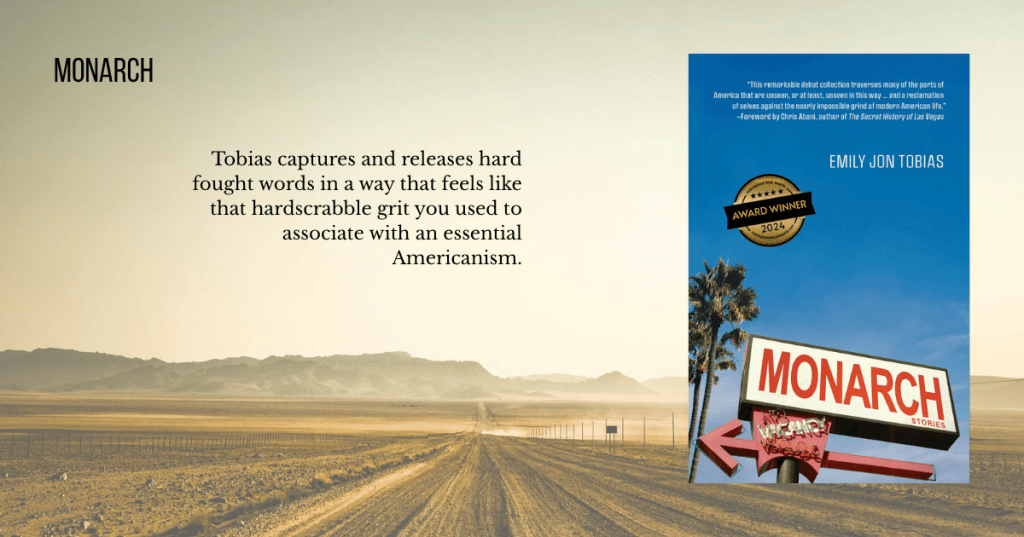
    Dusty road background and book cover of Emily Jon Tobias' short story collection, Monarch.

    In Emily Jon Tobias’ new collection of short stories, “MONARCH”, we are confronted by realistically flawed characters who are given the space to form, make mistakes, and heal. An award-winning writer and  Pushcart Prize nominee, Tobias was raised in the American midwest and now lives in Southern California.  The way she captures and releases hard fought words has a feel of that hardscrabble grit you used to associate with an essential Americanism. It’s all the more poignant that the characters in MONARCH are imperfectly real – addicts and sad girls, overwhelmed mothers and people whose tether to sanity has loosened. 

    Tobias plays with language and voice to raise her characters into existence.The title story stopped my breath and as I read, I had the distinct sense that Tobias was gleefully playing with her words, stretching out each sentence to its limit, a fullness like the protagonist’s intentional weight gain. My first inclination – trim these sentences, they seem too full created the sense I was as quick to jump to conclusions as the people who brazenly stare at Georgia and judge her size. Such is the subtle brilliance of Tobias’ writing – the excess was an intentional weight and slowing down that ties us to Georgia.

    We see this again in “Vida”, the sentences short and choppy with Wiley’s anger. Tobias’ characters are confused and confusing – which is what I feel most days. Which is to say, each is fully formed in their humanity as its splayed on the page for the brief glimpse we have as a reader. We are like passersby, sometimes witnessing these characters’ worst moments and the way Tobias intends to pull them through and heal some of the cracks. 

    The book includes a reading guide that is straightforward to use, and I think this book works well for readers looking to include more diverse character sets in their reading. It depicts largely heteronormative experience, while also giving space and life to queer characters. Upper level English class settings, as well as guided reading groups – there is intention in the way Tobias has cultivated this collection and guided readers to know the characters in their complete selves, regardless of identity or partner. The writing is accessible with beautiful prose, worth a read because of that alone. 

    Find MONARCH via Emily Jon Tobias’ website or visit your local bookseller.