Tag: world history

  • Hitlers Furies: Women Unleashed in the Reich

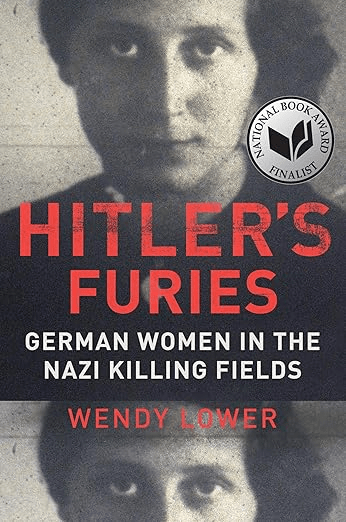
    A review of Hitler’s Furies: German Women in the Nazi Killing Fields
    As long as political ideologies seek to control the body and social lives of women, the personal will be political.

    I sometimes think it’s a trite and outdated phrase and then Roe v. Wade is turned over in the US and Nova Scotia announces an epidemic of intimate partner violence, and I’m reminded that in fact, no, the personal, the body, it is still political because men think it ought to be. Women have never asked for powerful men to make our bodies the site of moral imperatives and political objectives, to wield our bodies as the softer weapons of war.

    There is this idea that Nazism and Fascism uniquely appeals to men (there’s more Elon Musks than Laura Loomers in the world), and as a result, women were absent from the most terrible scenes of the crime (their domain children, kitchen, church), however we’ll learn how it was distorted and violent, all of it unbearably normalized, in Wendy Lower’s “Hitler’s Furies: German Women in the Nazi Killing Fields”.

    Originally published in 2013, Lower’s book is the result of twenty years of painstaking research into archives (notably in the post-Soviet Eastern Front), witness statements, and investigative work. It is chilling in the amount of everyday death and brutality Lower has catalogued and the straightforward way in which she has presented it all. Some critics at the time noted she did not include accounts of professional killers, like those in the Reich Security Main Office or SS, as mentioned in the linked Guardian article. I can appreciate the sentiment, but I think it’s even more sinister to consider the unending ‘normal’ and brutal ways regular women were part of the regime – secretaries shuffling files that sent hundreds to the death squads, after work ‘shopping’ for a new pretty dress in the discards of victims from the gas chambers. I am a regular woman, living a fairly regular life. Most of us are ordinary people, living ordinary lives and relying on the system and world around us to keep functioning as we expect. Their system slowly sped its way into destruction, those in power made substantial legal changes that eroded the entire known word and as we experienced through the pandemic, people still had laundry and a job and meals to make. The every day necessaries continue to exist. That’s a more unsettling and universal story.

    Wendy Lower first introduces the reader to what she calls the “lost generation”. Born in the tumult of Weimar Germany, with its blossoming civil rights, devastating economic and political turmoil and untold amounts of violence. There was as much promise, like Magnus Hirschfield’s Institute for Sexual Science and the women’s suffrage movement, as there was economic collapse and despair.

    This generation of women, disillusioned and morally lost according to Lower were perfectly primed to be swept into the National Socialist movement. The first two chapters of  “Hitler’s Furies: German Women in the Nazi Killing Fields” describes this environment and the perverse opportunity offered by the Nazis on the Eastern Front (as teachers, nurses and socials workers extolling Nazi “virtues”), notably once they’d made it impossible for women to find work they wanted. 

    The next three chapters describe the lives of six women sent to the Eastern Front and Lower ultimately divides the women between three categories: Witness, Accomplices, and Perpetrators. The most egregious actions were obviously taken by the perpetrators.

    There is something to be said for the women like Annette and Ingelene Ivens who were “exceptional after the war” (Lower, 89) for the ways they spoke publicly what they saw. They didn’t hide away their involvement in family chests and seek to hide behind their femininity, like so many of the perpetrators. They didn’t go to the Stasi after the war ended and trade secrets for their freedom.

    In the final chapter, “What Happened to Them?”, the answer is not much. White women, even women whose only power is the whiteness of their skin and their gender, have never been adequately punished for their murderous participation in things like the Third Reich or the murder of Emmett Till. The Guardian review accuses Lower of overselling her material, we know women can be violent and abusive, but we’re beyond it, and maybe that was the case in 2013, in the heady years of Obama, post-Sex in the City and Bridget Jones. But in 2024, 45% of white women voted for Trump. In his first days in office, he stripped away Diversity, Equity and Inclusion (DEI) programs that ensured employment for women and people of colour. Keep this in mind when you read chapter one of “Hitler’s Furies”. We’ve been seeing the rise of tradwife content which presents an idealized image of the mother who sacrifices all for the family. This idealized image, like that of Johanna Atvater in her crisp white apron, is a smokescreen. They don’t evolve much and only have one playbook. 

    Recommended to readers interested in women’s history, social history, World War II, German History and Fascism.

    I borrowed “Hitler’s Furies: German Women in the Nazi Killing Fields” from my local library.

    My recent reviews of women’s war experience can be found here: Devastating Minutiae in the Palestinian Experience: A Literary Review of Minor Detail

    Review of a Poet’s Memoir: Looking at Women, Looking at War by Victoria Amelina

    Did you know I’ve started publishing my own short fiction? You can find it over at Under the Poplar Tree on Substack. Be sure to subscribe, I publish a new short story every other Thursday.

  • Review of a Poet’s Memoir: Looking at Women, Looking at War by Victoria Amelina

    “What weapons do we choose to pursue justice in the hardest times?

    Victoria Amelina, Looking at Women, Looking at War

    The memoir “Looking at Women, Looking at War” is one writer’s journey to answer this question in the face of occupation and war. Victoria Amelina, children’s literature author and mother to a young son was confronted with this question on February 24, 2022 when Russia invaded Ukraine and her world was upended. The resulting memoir is her experience as a war crimes researcher and writer reconciling with her own identity and the “forever endangered Ukrainian culture”.

    An honest and intimate chronicle of her own experience, it is also of other extraordinary women in the resistance. Women like Evgenia, a prominent lawyer who were colourful clothing to court, but now carries a gun at the frontline. Oleksandra, her friend and mentor, who documented tens of thousands of war crimes and won a Nobel Peace Prize in 2022, though not one of her hundreds of cases went to The Hague in the seven years prior. The finer details like this sucked the air out of my lungs while reading. This book offers brilliant insight into the experience of women in and at war, but it is also contemporary evidence of Russia’s criminal attack on Ukraine. It is undeniable yet it continues.

    War is absurd and relentless and evil, a continuing slog of noise and death. Victoria Amelina captures the unspeakable despair and moments of joy that are the experience of war. It is an assault on the senses and in juxtaposition she writes of feeling disconnected and worn out. Body tired from the trauma and grief. Oleksandra tells her to take time and put cream on her face but to really feel it before she does anything else. How often do we do something similar? This sensory experience is a return to another time and a centring moment before she returns to recording war crimes and atrocities.

    This book could so easily be a litany of awful events pieced together, but it is instead a raw and lyrically beautiful account of a woman making her way in a world of war, attempting to create a path for justice. The awful things are alluded to but Amelina is a writer of grace and compassion, the reader can understand the allusions to violence and sexual assault without needing the details.

    The manuscript is unfinished. Victoria Amelina’s life was cut short by a Russian missile attack and she died on 1 July 2023. There are sentences left undone because of her death. Fragmented notes tell of awful Russian actions, like the small bit of a master’s work that could be seen on a FaceBook photo, posted by the Russian soldier who stole it Half of a sentence tells us about the death of a man miraculously rescued in another chapter. I had to stop reading and watch the crows in my favourite tree for a while after that. There is no ledger of fairness in war.

    Amelina reveals the bleak despair wrought by the violence of war and the fear of being close to death so that we can understand the small ways people are trying to retain their humanity in the face of war. The bag of walnuts a mother gives to Victoria after their interview. The reader is brought into the group of artists trying to save a snag beetle found on the sidewalk,their attempt to save an inconsequential life after the gut punch of learning about Volodomyr Vakulenko’s abduction by Russian forces. His death is a terrible thread woven through the novel and each time we are reminded that Amelina was writing about friends and colleagues. She is not simply an outside observer in this conflict.

    Reading this makes me consider what I would do if my country came under attack and I had to face the reality of war crimes and terror. Would I be brave and charge into the war zone to document the horrors done by the enemy? Would I find a sturdy basement and plead with my neighbours to find shelter with me? I should hope so, and I think we can hold on to what Victoria Amelina says here: “No choice made by those who want true justice is easy, and for most of us, the outcome of our battle is still unknown.” (p.10)

    Victoria Amelina’s roots as a storyteller can be found “Looking at Women, Looking at War”, evident as she set out to chronicle the lives of extraordinary women. In writing about the people in the embattled Donetsk region, we’re invited into her inner world and what made her courage necessary. Such is the cost of resistance.

    Recommended to readers who enjoy history and women’s literature. The memoir requires patience, broken sentences will never be fit together, we won’t ever have answers as to what she intended in some sections. The tragedy of war exists in these gaps. “Looking at Women, Looking at War” will be be published 18 February 2025 and available at all fine retailers and booksellers after that date.

    For further reading, check out Hunting for Vakulenko to read more about the poet and his abduction and murder by Russian forces. A murdered writer, his secret diary from the Guardian provides further context about Vakulenko.

  • Books I Read in 2024 that Made an Impact

    The following, in no specific order, is a round of eight books I read in 2024 that made an impact on me. The phenomenal books on this end of year list are not all new releases, some are a few years old and one is considered a classic. There’s fiction and non-fiction alike, murder, sex workers and difficult women. It doesn’t even encompass the many books I read or listened to that I truly enjoyed. These are the books that immediately came to mind when I sat down to reflect on what made me say, shit, that was a great book, then stare ahead and absorb the words. Without further ado, the Eight Books of 2024 That Made an Impact (on me):

    Whores, Harlots and Hackabouts, Kate Lister: Sensational. I listened to the audiobook, narrated by Professor Lister, and she has a fantastic northern English accent that carries you into the history. She is thoughtful in addressing a really difficult subject, compassionate and uproariously funny. Sex work isn’t the oldest profession, as she argues in the book, but it is very old and it is one that is frowned upon unless you have the right economic status and pretty face. History is ridiculous and hilarious, but it’s also a rich resource for us to learn and Kate Lister is one of my favourite guides.

    The Five, Hallie Rubenhold: The first Jack the Ripper book I read was the famous narrative that put forward Queen Victoria’s grandson as the murderer. We had recently moved in with my grandmother and I had started raiding her bookshelves (also where I found a sensationalized account of the Black Donnellys). “The Five” is nothing like that 1970s pulp non-fiction, though Rubenhold does reference it in her very well-done book about the five victims of Jack the Ripper. She eloquently breathes life and some agency into these women who were brutally cut down, their memory intertwined with their unknown murderer for generations. You can find my review here. 

    Sinister Graves, Marcie Reardon: This is the third instalment in the Cash Blackbear series by Reardon. I discovered the first in her series, the award-winning Murder on the River, as a happy accident at the library. Cash Blackbear is an intriguing Native American woman with abilities to see things not of this world and she assists a local police officer, who has also become her mentor and only family. Book four in Reardon’s series is coming out in 2025, so I’m looking forward to that!

    Parable of the Sower, Octavia E. Butler: Absolutely quintessential and necessary reading for anyone who is interested in speculative fiction and post-apocalyptic stories, but also philosophy and the human experience. Butler is an absorbing writer, her broken world, before it became that way, is unsettling in how familiar it is, but that is why post-apocalyptic storylines work so well. They are both a cautionary tale and a horror that could never happen. 

    Difficult Women, Roxane Gay: A powerful, painful and beautiful collection of short stories. Roxane Gay is a professor, editor, social commentator (from Twitter to the New York Times) and writer. This collection is raw and spectacular, it reveals bits and pieces and of what makes us whole.

    The Wife Between Us, Greer Hendricks and Sarah Pekkanen: A slow burn psychological thriller, “The Wife Between Us” is a great read as the weather chills and you have the opportunity to sit snuggled up by a fire. The storyline takes us back and forth between Vanessa, the scorned ex-wife of Richard, and his new fiancée Nellie. The women’s lives are intertwined in ways the reader would never expect. 

    Calling My Deadname Home, Avi Ben-Zeev: I loved this incredible memoir by Dr. Ben-Zeev. An honest and very loving look into the life of a trans man trying to heal himself and the journey with his family and loved ones. You can read my review here

    As 2024 unravelled and unfurled into whatever will come in the next year, these books were more than just stories. Each brought its own wisdom, touch of magic and introspection, growth and tears, which is a testament to the formative power of reading. A well-told story can change how you see the world. 

    What were books that impacted you the most this year? Share your favourites below in the comments, I’d love to hear other readers’ reflections and recommendations.

  • A World of Lies: Review of A Short History of the World in 50 Lies

    A quick and interesting read, I’m delighted I immediately tracked down and read  “A Short History of the World Told in 50 Lies” after I heard Natasha Tidd’s interview with Dr. Cat Jarman on the History Hit podcast Gone Medieval (it’s from the back catalogue in the series).

    The fifty stories are told in chronological order, beginning with an ancient king lying his way to the throne and ends with the relatively recent Chernobyl Disaster.

    It’s an unsettling truth that “fake news” is not a new phenomenon, created out of nothing by Trump and his ilk. Apparently Julius Caesar was one of the first to give the spin doctors a go, and it’s been a heavily entrenched practice ever since that the powerful lie and get away with it, typically only felled by their own hubris.

    Some of these lies have held on for longer than anyone could have imagined, the sort of conspiracy-laden shit the far right will peddle to sow fear and mistrust. There’s something exceptionally depressing that the story Simon of Trent, a twelfth century blood libel case, resurfaced once again only a few short years ago.

    Tidd accounts the tragic story of the Tuskegee Experiment that continues to have an impact on Black Americans, to the adventure and might of Jeanne and her Black Fleet sailing the English Channel on her mission of revenge. 

    Recommended Reading Level

    A very approachable read, “A Short History of the World in 50 Lies” is the perfect vacation read for history buffs, a general audience who wants to know a little bit about a lot. Natasha Tidd’s voice is friendly and I definitely recommend!