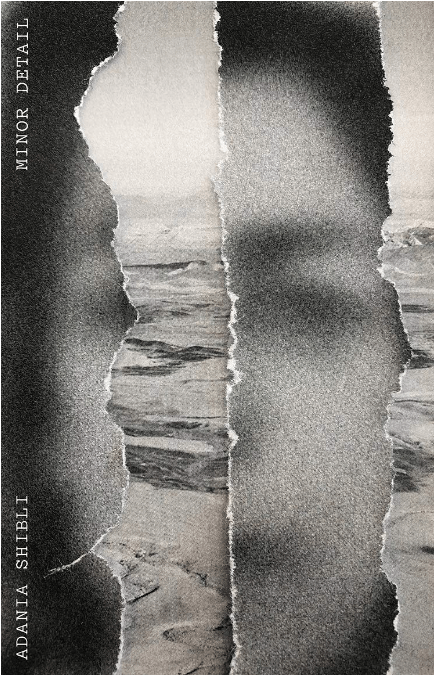
Recently, while combing the Libby archive, I came across the audiobook of “Minor Detail” by Palestinian author Adania Shibli, translated by Elisabeth Jaquette. “Minor Detail” immerses the reader into the summer of 1949, one year after the horrific Nakba where around 700, 000 Palestinians were displaced. In this already violent and oppressive environment, Israeli soldiers encounter a Bedouin encampment and proceed to kill the group of unarmed Arabs, except for one scared girl. The soldiers eventually kill this young woman and bury her in the sand of the Negev desert. Years later, in a present-day similar to our own, a young woman in Ramallah comes across a newspaper article about this terrible history and attempts to learn more about the crime, notable to her because it was committed exactly twenty-five days to the day she was born. This incredible fiction novel is a devastating look into the banal minutiae of life under oppression.
The novel is divided into two equal parts. Part one is the narrative viewpoint of an Israeli army officer who has been sent with his men to lead patrols of the desert to ensure it is free of the nomadic Arabs who lived there. The soldiers find the Bedouin encampment and kill all the unarmed people and their camels, the oppressive heat and details of the blood seeping into the sand evoking a deep seeded, visceral discomfort with state sanctioned imperialism. It is from this encampment the soldiers take the unnamed Bedouin girl they will murder.
Shibli very effectively builds tension and discomfort by constantly revisiting the exacting details of the officer’s infected spider bite on his leg, the measured ways he cleans his body each time he returns to his tent, the care he takes in dressing the wound and ridding his space of any other spiders. He is fastidious in cleansing away rot, within himself, his own troops and the desert. Shibli’s writing is very tightly wound in this section, the close heat and dank smells seem to rise up around the reader.
The second section of “Minor Detail” follows a young, unnamed Palestinian woman after she encounters a newspaper article about the 1949 murder. She is drawn to the story and feels compelled to learn more about the crime and the victim. There’s a longish section where she muses about her own narcissism that is a bit much in its melodrama, reminiscent of a teenager’s navel gazing, but I think the overwrought language has more to do with translation than Shibli’s writing. There’s another passage that overuses the word “leaped”, to the point of distraction but again, some nuance and lyricism can be lost in translation. The rest of the writing is evocative and lyrical, in spite of the violence and cruelty that is sometimes depicted.
Our narrator is forced to navigate a land under occupation as Palestinians can only make their way around Israel in very controlled and contrived circumstances. In this way we see how the barren landscape, once it was cleared of nomadic Arabs, has been built up to be a very tightly institutionalized space. The chaotic violence of the Bedouin girl’s murder has given way to cities and countries in controlled zones with permits that are enforced with ruthless zeal. We experience the shifting borders of these controlled zones with the narrator as she switches between multiple maps in an attempt to plot a course through a land once hers but now marred by institutions that bar her entry.
Shibli’s writing is subtle and poetic, with a magnetic pull into overbearing heat and tension. We know the violence takes place and we know it is brutal, but Shibli deftly carries the reader around and past the acute action of violence and into its aftermath. In this way, she is evoking that sultry heat of a sun-baked desert that throws up mirages and disorients the experience.
The sexual assault and murder of the young Bedouin woman in 1949 is a true story, one small unbearable story in a terrible war. A devastating microcosm of the whole. This is the true, horrible beauty of Adania Shibli’s “Minor Detail”, each observation carefully and tenderly drawn out. Regardless of politics, recommend to readers interested in fine literature, perspective changes in fiction, women’s experience in writing.
 Joy Reads Books
Leave a reply to Hitlers Furies: Women Unleashed in the Reich – She Reads Books Cancel reply